

Got Goblins in Your House?
Wondering Monsters Podcast, Episode 28: Got Goblins in Your House? |
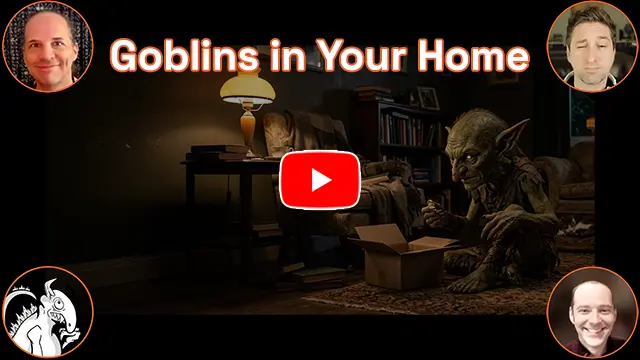
Monster Ranking: 3.5 Monsters


What Are Goblins in Traditional Folklore?
The discussion begins by separating classic folkloric goblins from the fantasy versions most modern audiences recognize. The hosts explain that traditional goblins were not giant sword-wielding cave creatures like those found in fantasy worlds inspired by The Lord of the Rings
or tabletop roleplaying games. Instead, historical goblins were often small, misshapen beings associated with homes, farms, mines, and places where chaos and disorder flourished.
In older European folklore, especially in France and the United Kingdom, goblins were believed to dwell behind walls, beneath floorboards, in attics, or hidden in dark corners of the home. They were usually described as tiny humanoid creatures with large ears, glowing eyes, sharp teeth, and earthy or sooty appearances. Some resembled creatures made from dirt, ash, leather, or fungus-like material. Their appearance reflected the environments they inhabited.
Unlike demons or deadly monsters, goblins were often more mischievous than outright violent. They hid tools, pulled blankets off sleeping people, knocked on walls, caused strange noises, and created endless inconvenience. In many stories, goblins seemed attracted to emotional tension, messy households, broken farms, or environments already descending into chaos.
The hosts repeatedly return to the idea that goblins are essentially “chaos spirits.” If a home became disorderly, emotionally unstable, or neglected, goblins supposedly moved in to make things worse. They were viewed almost as supernatural scavengers feeding on confusion and dysfunction.
Goblins, Brownies, and Hobgoblins
One major part of the episode focuses on the blurry boundaries between goblins and other folkloric beings. The hosts compare goblins to brownies, hobgoblins, boggarts, bugbears, and red caps, questioning where one category ends and another begins.
Brownies, unlike goblins, are traditionally helpful household spirits. In Scottish and English folklore, brownies might clean homes, perform chores, or assist farmers during the night. However, if mistreated or insulted, brownies could become destructive and hostile. Some stories describe a brownie transforming into a boggart after being angered.
Goblins, by contrast, seem inherently mischievous from the start. Rather than becoming chaotic after provocation, they are drawn toward chaos naturally. The hosts argue that goblins do not appear interested in harmony or helping humans. Instead, they seem to thrive on disruption.
The conversation also explores hobgoblins, which historically referred to smaller household goblins associated with hearths and homes. In some traditions, hobgoblins were actually friendly or neutral creatures, again highlighting how inconsistent folklore classifications can be.
Throughout the episode, the hosts wrestle with a recurring question: is “goblin” a specific creature, or simply a broad label humans apply to many different kinds of supernatural beings?
Mining Goblins and Wilderness Tricksters
The podcast also explores regional variations of goblin lore, particularly Welsh mining goblins. These entities were said to dwell in mines, where they knocked on tunnel walls, misled miners, or guided workers toward danger. Their behavior resembled supernatural tricksters rather than outright killers.
The hosts compare these stories to other folkloric creatures that lure travelers astray, such as lantern-bearing spirits and will-o’-the-wisp legends. These entities occupy dangerous wilderness spaces and often lead people into swamps, cliffs, or deadly terrain.
Again, the line between goblin and other folklore beings becomes difficult to define. The hosts note that many creatures later labeled as goblins originally possessed their own names and identities within regional traditions.
The Kelly-Hopkinsville Goblin Encounter
One of the most fascinating parts of the episode examines the famous 1955 Kelly-Hopkinsville encounter in Kentucky, often called the “Hopkinsville Goblins” case. This bizarre event involved multiple witnesses reporting strange glowing creatures surrounding a farmhouse after a mysterious object was seen in the sky.
The creatures were described as small, thin humanoids with metallic or glowing skin, large ears, and strange movements. Witnesses claimed the beings peered through windows, approached the house, and survived repeated gunfire with little visible effect.
The hosts note how closely these entities resemble both traditional goblins and modern alien archetypes. The creatures reportedly moved in jerky, unnatural ways, flipped backward when shot, and behaved more like trickster beings than conventional extraterrestrials.
Skeptics later suggested the witnesses may have mistaken great horned owls for goblins, though the hosts jokingly point out how often owls appear in paranormal explanations. The discussion raises larger questions about whether folklore creatures, UFO encounters, and paranormal entities may all belong to the same broader category of unexplained phenomena.
Pop Culture Goblins and Fantasy Evolution
The episode also examines how goblins evolved within popular culture. The hosts discuss early childhood influences such as Labyrinth
, animated versions of The Hobbit
, Ghosts ’n Goblins
, Fraggle Rock
, and fantasy gaming worlds like Dungeons & Dragons and Warhammer.
Modern fantasy goblins differ dramatically from folkloric goblins. Fantasy versions are often tribal, militaristic, or monstrous species living in caves or armies. Traditional goblins, however, feel much more intimate and unsettling because they invade human spaces directly.
The hosts also discuss how goblins eventually became tied to Halloween imagery, witches’ familiars, and black cats. Victorian art played a major role in shaping the now-familiar image of green-skinned goblins with exaggerated features.
Why Goblins Are Still Creepy
By the end of the episode, the hosts attempt to rank goblins on their personal “monster fear scale.” Although goblins are not usually portrayed as deadly predators, they remain deeply unsettling because they invade spaces that should feel safe.
The idea of waking up at night to find a small humanoid creature lurking in your kitchen or crawling through your walls strikes the hosts as uniquely disturbing. Goblins represent a breakdown of domestic security. They are manifestations of disorder entering everyday life.
The hosts conclude that goblins may serve as symbolic warnings about chaos itself. Clean your house, maintain order, avoid emotional dysfunction, and perhaps the goblins stay away. Let life descend into disorder, however, and folklore suggests the goblins arrive to make everything even worse.
Whether viewed as folklore, paranormal entities, symbolic archetypes, or misunderstood creatures, goblins remain one of mythology’s strangest and most persistent supernatural figures.
Links from the Show
- Are Ghosts Real? What's REALLY Happening?
- The History of the Boogeyman
- History of Witches, Witchcraft, and Folklore
- Gremlins, Technology and Supernatural Sabotage
- Leprechauns: Real History of Irish Folklore, Fairy Law, and Hidden Treasure
- Mothman and a Horrific Bridge Collapse
- Nessie Cryptid History: The Truth Behind the Loch Ness Monster
Watch & Listen to the Full Episode
Enjoy where the conversations of silly meet strange at the Wondering Monsters Podcast.
Watch on YouTube Watch on Spotify Listen on Apple Podcasts Listen on Other Platforms
Licensing Information
- Title: Entry of the Gladiators
- Composer: Julius Fučík
- Library of Congress (Public Domain)
- Podcast theme song version edited/arranged/mixed by Dan Swift
Unless indicated, images appear in their original form.
Images were generated using AI from MyNinja.ai, NightCafe, lenso.ai, Gemini, or ChatGPT
Transcription
*Transcription was automatically generated and may contain errors.(Music)
Baba: Goblin got your goat?
WDG: The arbiters of--
Baba: Nope, it was a chupacabra. (Laughing) So yeah, speaking of the arbiters of chaos, goblins, that's what we're gonna talk about. So yeah, let's dive into it. First, we hit the trifecta, right? We did ghosts, which is now, it's goblins, of the Halloween archetypes, right? It's like, so there's, you know, which is the, we're left off of the video game ghosts and goblins, I think they've, unfortunately-- They got the short end of this.
WDG: Yeah.
Baba: Short end of the-- Even though it's mostly like, seems to be like demons and things of that, and zombies, and not really ghosts and or goblins in that, yeah. Goblins, not at all pretty much what we think of. There's not really green goblins, like in the sense that we think about them. That's definitely a function of stuff that's later, like Victorian era type of, you know, iconography that kind of goes on, you know, past that. Goblins are usually more like earthy looking creatures. They might have a greenish appearance to them, but it's gonna be more of like that. They tend to be, in some cases pretty small, like a foot high. They also generally tend to be stationed around like homes, farms, and sometimes mines. They often will have like a sooty appearance, if they're like a mine goblin, they might have like a brownish appearance, if they're like a house goblin. They look like stuff that's kind of come out of the earth. They tend to be like that. They're fairly small, they have large ears, really big wide mouths and like sharp teeth, and eyes that either glow like kind of red or yellowish. So not at all like current kind of, certainly not like the Tolkien goblin or the things like that. They, it's yeah, and they, like when they're in homes or whatever, they tend to be like in attics or under the floorboards or behind the walls or things like that most of the time. And it seems like-- A good place to start your goblins. Yeah, so it's a very good, and they like, and so like it's, yeah, like they seems to be like they're a manifestation often of like when everything's going awry in the house or on the farm, they kind of show up to further cause mischief. So it's like, they like, so if like things are dirty and things are messy or like things are broken down or stuff like that, the goblin will show up and it'll like hide stuff and mess with things. And if there's a lot of like chaos going on with the household, like high emotions and things like that, goblins will almost have like a slightly poltergeisty type effect. Usually it's not like very harmful. It's usually like hair pulling or grabbing people's sheets or like, you know, stealing things and you know, like this kind of like knocking on the walls, keeping people up at night, you know, like they're just, they're always like kind of messing with the head and it's like, and it's usually not, usually doesn't result in like a very like violent outcomes, but there are some stories like that. Yeah, as far as like the like general like origin for the most part, goblins tend to be mostly like regional to I'll say like more like France and the UK is like the traditional goblin. There's other things where it's like the name might come from a derivative of cobalt, which is, you know, Latin for like rogue, Dave mischief. It's like, but it's usually like, it seems like the earlier stories, the like early medieval stories are like French and then they kind of migrated up to, into like the UK area and they kind of, in certain cases I feel like they mixed with other stuff. So like there's a Scottish story that's like about like the idea of like, it's like the brownie, which is another like house spirit that's usually friendly and helpful and gets pissed off and turns into, they call it like a Bogart. Like, so I think we talked about that before, but like Bogarts and like kind of like bug bears, you know, it's like this kind of thing, but that, but to me, I don't think that really is like goblin, like that feels more like you pissed off a brownie and brownies just can get also get pissed off as a spirit and wreck stuff if they want to.
WDG: So it's like, is related to boogeyman in terms of the, wordage and symbol.
Baba: Bug bear and so it's a, yeah, so, but, but yeah, but goblins like feel like, I feel like they're like, they're on their, like, like, in that case, it sounds more like it's a brownie, it's mixed up with a brownie story. And it's like, they're generally like, so they're almost like the, like a, I guess like a negative house spirit, you know, or negative far, like, you know, it's like, sometimes they'll do things like in the mining stories, like the Welsh have a version of the goblin and I'm not even going to try to pronounce it because it is, pronouncing Welsh words is very difficult. It's like, they basically will knock on the top on the mines and sometimes they'll lead miners down the wrong like down the wrong path or into trouble, you know. So it's a, but yeah, the, like the house ones tend to be more like that, like just the harass things, they will ride the horses, they'll ride the cat around. And it does seem that, like, when you get into like a kind of like the modern version of say our Halloween icons, right, like the, the, the cat, the witch that goes, goblins kind of like tended to morph with the cat because like there was a, you know, like Lisa Victorians off goblins, why they ended up being green is because they're stark and stuff like that. And they were goblins were sort of like witch familiar is later like on. And so then they became, and then there was this idea of like goblins maybe could shape shift into cats. And therefore like, and then they just kind of dropped the goblin and they became like the cat iconography as the familiar kind of chaos spirit, which makes sense. Cats are cats can be a little chaotic and mischievous house spirits and temperamental sometimes. So it's like, so it kind of like has this kind of similar idea to it, but, but yeah, there's it's, but like similar to our like Gremlin episode, like goblins, you seem to be very focused. And like, if you tidy up the house and you stop being a jerk to your family or whatever, you know, like, and temper is cool and everything goes right and you keep the farm clean, then the goblins might tend to just go away. Like they, they tend to leave or, because I guess it's not chaotic, but sometimes you can give them offerings to get them to go, like, you know, give them some, like, some milk or something. And then they might just get move on. And then they have like more extreme, like, like, like getting rid of stuff like Fay type things, you know, like iron and stuff like that, you know, but tends to be like, that's more of like a later kind of thing. Like when they got mixed up with, cause they don't seem, they're not a part of the fairy tradition. They're kind of their own, their own thing, you know? So yeah.
WDG: But you can, but you can see the similarities, the things that are like have a similar shape in a sense to the Fay, the earth spirit aspect of it. The sometimes, sometimes the smallness, it's not unrelated to something like the leprechaun and the brownie itself is often thought of as being almost like a house version of, of the Fay, but it's kind of like these, these, like, these other things. It's like, they're not really ghosts, although sometimes they have similarities to things like hauntings and poltergeist phenomena, as we talked about. And yet there seems to be sometimes a creatureness to them to the point that sometimes like stories about them are, are mixed in with the, the UFO world. And on another end, it kind of touches a little bit on the troll world, which will probably be a discussion we'll have to get into at some point, which is yet different than giants. Which I am afraid we probably will, yeah, we'll probably get into that too. But these other things that seem to be, so there are some things that seem to be ghosts. There are some things that seem to be creatures. There are some things that, and then goblins, goblins seem to be more in that creature world in a lot of their ways, although some of their things do mimic ghosts.
Baba: Well, there's like the, you know, the, you know, think of like some of our previous stuff about like, you know, night hags and things like that. Goblins like sometimes get thrown in with that kind of stuff, like a sort of night terror kind of things, you know, same thing, cause they have like glowing eyes and stuff like that. But like, it does seem like versus say like, haunting poltergeist or hauntings, it's like, they don't just like, like they can just show up. Like it's not like, like poltergeist might be there because your house is haunted because somebody died or something like that, whatever it is, or like, you know, whatever the cause of that's causing the like poltergeist phenomenon, but goblins just like are like, everything's like going wrong here. And they just kind of like are like, oh cool. Like, and like, I'm going to do this.
WDG: Just fits in with me.
Baba: Yeah, like this is like my jam and they show up and they start helping like rec stuff, you know, it's like, and, and cause they're just like, they seem to just like to be like, kind of like, ha ha, this is funny. And you know, like, kind of like, I think of like a, you know, like, like a teenager is like, they walk past like a place that's kind of already burnt down. It's like, oh, this seems like a good place to like cause some trouble where we can cause trouble and maybe not like directly get into, you know, it's not like they're not breaking into a convenience store. It's just like a broken down like warehouse or something.
WDG: Yeah, like here's this abandoned property. Let's go wrap it up. Like here's an old mess. They're all pentagrams.
Baba: Yeah, so it's like, goblins have that kind of vibe to them. They're just kind of like, like, they're a little bit chaotic. I mean, modern goblins tend to like, it's, I feel like right now too, like in the more recent things with like D and D hitting like peak popularity a few years ago and things like that. And goblins have kind of come back. Maybe they'll make it back to the Halloween stuff that they once had of, you know, it's, and not the like, like, like Tolkien, like high fantasy goblins, which feel like they're more like some kind of,
WDG: They're like a bit of a different animal.
Baba: Yeah, they're not, they're not how spirits, they're like giant, like, like they're creatures, you know?
WDG: What gets caught, yeah, like the way a goblin takes shape depends on how people have been shaped at that point. Like what level of domestication are humans at? And that's gonna show you a little bit about the level of domestication of the goblin, you know? Because like, if you go back, back, it's kind of like, it's very much the, you don't have any kind of, like once you travel out on that road, you're really rolling the dice. I hope like you brought something sharp and enough people, (Both Laughing) because like, you don't know what you're gonna encounter out there. And that's like these, you know, where you've got the conflation of goblins and crossroad spirits and road spirits, like where they mess with travelers. You've got things like the red caps. Did you guys encounter the notion of the red caps in your--
Baba: Yeah, I did, I felt that they were like a little, just like, you know, like slightly just, you know, they're in the same vein of that kind of like creature. There's also, again, there's another like, well, it's not a goblin, it's its own distinct thing, but he is like a lantern, carries a lantern and leads people off the path, you know? People think it's like helpful. And it can be, if you're nice to it, again, these things are-- Yeah, the will of the west, right? Yeah, it's like sort of like that. And it's like, but it's a little shadowy creature that carries a lantern, but sometimes it leads people like to the edge of a cliff or something and like blows the lantern out or something like that. But those are like, but those are very much like straight up like trickster, I feel like trickster type spirits out in the wilderness. And goblins are definitely more like down in the, like they're getting into like business in the more, you know, like inside of like homes and stuff.
WDG: You know what that like, so there aren't that many things that are goblins that are called goblins. They're called other things. And so it's like where we decide to draw those lines, see, because we're gonna do it with ghosts in the same way we did with witches. You know, where does one thing end and another begin? Like what's a goblin, what's the fae? And I think actually the more you poke at it, the more you realize actually none of those boundaries hold because like, because when you start using any other criteria, you realize actually that like, it's kind of wiggly. Like you've got things like, so you've got like goblins in literature, right? You've got like the goblin market. This is what it's a poem about these kinds of things. These goblins are kind of animal like. They sell this enchanted fruit and they're trying to lure women into eating it.
Baba: It's similar to when we talk about leprechauns, like goblins have like these kind of big ears and they have this like really wide, like tooth grin thing. They have like glowing eyes or usually red or yellow, sometimes, you know, it's like, but it's just kind of like it goes into that weird, like their proportions are weird and they're very small, you know, I don't know. Yeah,
WDG: like smallness definitely seems to be a quality of the goblin, like if you had goblin rules, smallness would be part of them.
Baba: Three apples high probably. No, wait, that's basically goblins, right?
WDG: But like a brownie is specifically something that lives in a house, is it not? Yeah, like yeah. And so like, and that's living in a cave or a mine. Right. And there's a difference between like wanting to have your house tidy and warning you about a cave in, that might happen, you know what I mean? So it's like, they don't necessarily stick to the same habitat. So, and a cobalt is a cobalt. Yeah. And a brownie is a brownie. But a goblin is all of these things? You know, is it a wider net cast around these things? And then how do we stop that net from being cast around, like things that are called goblins, like that, is it Tennessee or Kentucky? See, I'm gonna do it. I do it to my own citizen people too. Yeah, Kentucky or Tennessee, the Kelly'sville Hopkins, Kelly Hopkinsville, I'll have to pull it up. Do you guys know what the hell I'm talking about? It's called a goblin. See, I wanna hear what you guys looked into as well, because these are things that come up when you search for a goblin. Dan, what you got? Why don't you riff on something for a second? You've been quiet as a church mouse over there.
Danny C: Well, the one thing I wanna mention real quick, you know, we talked about, well actually there are a couple of things swimming in my head right now. So sidebar slightly, going to pop culture a little bit, does anyone know in the book slash movie of which I have not read nor really seen, which is very appropriate for me to be commenting on, Cat's Eye, Stephen King, was that technically a goblin in that, what was in that? Does anyone know?
Baba: I think it's like, I didn't read the, I haven't read the book, but it's like, but I do vaguely recall the movie. I was actually gonna mention, ask like, what's our first experience with goblins? But I think that is a goblin. I think it's supposed to be, I mean, which kind of, it's about the right, it's like weird, because it's almost like a mix between a goblin and, but the whole like behavior of like sucking out the breath of people, that's not really goblin, traditional goblin behavior, but the coming out of the walls and the, you know, so it's-- And I
Danny C: think I rode the cat too, didn't it?
Baba: Yeah, well, I think it's like, I think he becomes, I think when he sucks, if I'm remembering correctly, because it's like, I think as they suck the breath out of the people, they transform into cats or something like that. I think the cat is trying to chase it down because like the goblin or whatever creature turns people into cats, you know, by like doing that. I think I'm pretty sure that's the, so it just makes, yeah, kind of in that, kind of the thing, it fights the cat though. Maybe I'm thinking of that, okay. I think it has like a little sword, like-- Yeah, yeah, yeah, that or a spear or something like that. Yeah, something here, yeah, something, yeah. But yeah, that feels like that's a kind of like, it's probably like a mixing and riffing on a couple different, yeah, like things in that sense. But yeah, I was actually gonna say like, what's the, I tried, because I was actually trying to think about it, I was thinking about like, what's the earliest version of goblin that I encountered that, like, and I was like, yeah, so I figured like, what's that for you, Dan? What do you got on that? Can you remember the--
Danny C: I'm gonna do a toss up between, between the Stephen King book slash movie "Cat's Eye" and the video game "Ghosts and Goblins." I don't know that I had a very clear memory of when my first exposure was, but I'm gonna say it's something kind of like that, but I don't remember.
Baba: Yeah, I was thinking like, it was either gonna be the like, "Ranking and Bass Hobbit animated cartoon," because that's like, probably my first exposure to like, Tolkien stuff, not knowing what that was, you know, just knowing, oh, it's the Hobbit cartoon. Or like, "Labyrinth," that was a-- Wow! You know, it's just like the, because it's like, that's a, yeah, and like, you know, I remember that being kind of scary. And then like, and then again, that's another thing about turning people, like turning, like, what, kids into goblins, as opposed to goblins turning kids into cats, I don't know. So there's this weird transformation thing, but it does seem to be like, but they're like, called it out on a different dimension and stuff, you know. But yeah, like it's, yeah, those are probably my things. What do you got?
WDG: Yeah, "Labyrinth" was the one that I had in mind, and also that animated Hobbit. Yeah. The animated Hobbit continues to be one of my biggest formulations for goblins. That, and just only later to be altered by Dungeons and Dragons, playing Dungeons and Dragons. And, well, "Hero Quest," I guess, before Dungeons and Dragons, because that's got that classic shape of the goblin that we think of when we think of that D&D world, the, you know, it's like, two to four feet tall, and kind of, (Imitates Droning) you know, if they show up, they might show up with the kind of music that the grim reaper does in "Kid Icarus." (Imitates Droning) You know, that kind of like, you know, the disturbing, like, Lovecraftian, like, discordant horn trumpet from hell, or, you know, I don't know. But yeah, that, I think that would be so probably so similar. "Labyrinth," "Labyrinth" probably, and "The Hobbit" being the big ones until, until "Hero Quest" and D&D around the same time, because it wasn't long after "Hero Quest" that we just started playing D&D. So, yeah. Well, did you confess already? I guess you already said the, "They're Hobbit, they're not Hobbit." Are there goblin-like creatures, though, that also would have been in our little world of, I didn't watch them at the, but "Fragal Rock," the "Fragals" are kind of, they live in the walls, they mess with your pets, they live in your kitchen or whatever, they, you know, they're part of this ecosystem.
Baba: Another, another, like, it's the, it's the light, Henson, though, versus the dark, so it's like, it's the same, but I'd be like, that's
WDG: also why-- What year were the "Fragals"?
Baba: "Fragals" or "Fragal Rock" is probably very close to Labyrinth, I would imagine, in the, like, same kind of thing, something you like.
WDG: 83, he was field-testing it to see if he could get his dark--
Baba: Well, I think Dark Crystal predates Labyrinth, you know, and those have little beard guys, too.
WDG: I wonder if he got punished for dark, well, yeah, well, and I was thinking Dark Crystal, and I was like, "Doesn't Dark Crystal have goblins?" And I was like, "No, no, it has the Skeksis, "and the Mystics, and then you got the Gelflings."
Baba: Yeah, the Gelflings are nice, they're fun.
WDG: But that's the thing, they're just, the Gelflings are almost like, they're just the population of the world, like, I don't know, they're the people of Dark Crystal world. I don't know what that world is called. Is that just an earlier version of Earth, or is it one of these other, let's get back to goblins.
Baba: Good God, good God! Sorry, I really let us down this tangent of, you know. (Laughs) So yeah. Goblins, though.
WDG: Oh, and then there's, so let's talk about the Tolkien goblins, because goblins and orcs are not really different things, although the movies would tell you otherwise. They're just other names for the same thing, apparently.
Baba: Yeah, they're just dark elves, essentially, like, or elves that were corrupted, or something along those lines, which is like-- Which is like also, I don't know, kind of takes the, I like the more party-- I like the variety.
WDG: I like the variety. And I do like what happens to orcs when they collide with D&D slash Warhammer worlds. Specifically Warhammer worlds, which goes back to your comment on the chaos there. Bill, because don't orcs come from
Baba: the chaos, or the realm of chaos? I don't think they're straight, because there is like, at least in 40K, there's chaos beings out in the-- Okay, yeah. In the, almost like, they're more like, almost kind of like crazy, you know, like love cr-- Like stuff that's out in the warp, you know, when you go between space, there's like that. But orcs are kind of, I mean, they're, I guess, kind of chaotic in their own sense. But I think, and you can come at me for not knowing my 40K stuff, but I'm pretty sure-- Please, put it in the comments. Paying attention. In 40K, are, they're kind of like grown out of like a, almost like a fungus. They're almost like mushrooms. Like, you know, it's like, which actually is kind of like more traditional, because goblins, traditional goblins kind of feel like earthy junk or stuff that's come to life, right? Like they can look, they can kind of look waxy, they can kind of look, you know, like leathery, they can kind of look like sooty, like they look like, it's almost like, again, the chaos of the, of your messed up thing come to life. Yeah.
WDG: There's also a like-- They're feral, they seem feral, don't they? Yeah, yeah. And that's back to that corrupted elf thing.
Baba: Yeah, it's, but I don't think they're like, but there's like a, they do have a, like a similar, like a much more like mild vibe of like the boogeyman, but it's almost like a boogeyman for like, you better pick up your stuff and keep your house in order, otherwise, you're gonna have goblins, they're gonna show up and they're gonna like-- Yeah, they're like a corrective mechanism. Yeah, they're like, in a sense it's like, or like a sort of like, yeah, like sort of a punisher, but if you keep everything in tiny, they move on. Or if you're also not like a horrible person, you won't get goblins, right? They won't show up like, cause they're not gonna be like, they're like more attracted to that, like kind of like chaos and disruption. And so if like, if everything goes back to harmony, the goblins like, the goblins leave. So there's like, so there's like a weird like, but they're not like gonna grab you in the dark and eat you or something, you know? It's like, they're just, they're just kind of there to be like, again, like walking past a place, there's a lot of chaos, let's go cause some more. It seems like a place I should hang out cause I'm a goblin.
WDG: Unless, unless the red caps, because those guys, they'll kill you.
Baba: Right Dan, throw it, start vamping while he's doing this.
Danny C: Well I'm about ready to jump into the Kentucky story.
Baba: Okay, yeah, yeah. Oh good, good, you on it? All right.
Danny C: So I, it's very typical of me. This is my role as this show slash podcast. I bring like half of the story. And the audience has to research the other half.
WDG: I've got part of the story too.
Danny C: Cool, cool, so maybe we can make something whole out of it or maybe close to whole. So from what I remember, there was, it was like in 1955 in Kentucky, I think it was a farmer, I could be wrong, a guy, a person, a person sees a glowing object in the field. Later, a being is walking towards the house, long and slender, metallic like skin. So it almost immediately reminds me of, you know, a stereotypical gray. But I believe reported pointy ears, which would not be what you would see on a gray. The thing was like looking around the yard, looking around the house, like on the outside, I think peering into the windows, I think. The person ends up getting a gun and like tries to shoot this thing. I don't know if he, if the person missed, if the bullets ricochet, I don't remember.
WDG: It encountered, they shot it. It, they describe it as flipping backwards. (Laughing) And then it just kind of retreats into the tree line or whatever. And then they notice another one looking through the window and they shoot that thing. And with similar effect, like it, it startles it and shocks it.
Baba: But these, this is the thing where people were hunting or something and they were in a hunting lodge. Is this that? No.
WDG: Okay, I'm just thinking about you. No, no, no, that's often considered a Bigfoot one. I know the one you're talking about. They get pummeled, they get pummeled with stones and all that, yeah, that was crazy. Okay. No, but this, yeah, this is, but this was, so this continues. They continue to get sort of harassed by these things. And then they make a break for the trucks. And they take off for the police station. They tell the police what's going on. The police come back, they do a search. And the, they don't find anything, so much of note, right? No goblin tracks, no little swords, no funny music, like I described earlier, is playing at the time. And so they, and they, so the cops go off. And so they, and so I think the people come back, I don't know if the cops come without the people, do the search, but the people come back and so do the creatures. And so they're dealing with like being attacked by these things and they're knocking on the windows and making all kinds of, and trying to-- It was the police all along. They say they have claws and they, probably was, you know?
Baba: They were knocking on the, that play of the trickle.
WDG: There aren't many things I put past police. And in the 1950s, I wasn't around, so I can't put anything past them, but I would say they'd probably do this kind of thing. And if you disagree, put it in the comments. And I want to know what kind of police are you that are watching this? Yeah, Dan, please.
Danny C: So similar to the Mothman episode that we did, and that major account that we covered very loosely like we do, and there's more than one person that witnessed this. So at least two people, because that's the definition of more than one, there are at least two people, and visibly, I don't know, shaken, but definitely when they went to the police, they were, it seemed to be the case that this was legitimate. It wasn't, everything goes along with that. And there were also bullet holes that were found in doors, windows, that kind of thing, which honestly could have been from any point in time, not necessarily that night. Because it's Kentucky. Because it's Kentucky. Burban could have been involved one night having fun. Maybe they're just covering their tracks. They're trying to get an insurance claim. I don't know, but we gotta cover all of our bases here.
WDG: With love said for Kentucky, by the way. Not that I've ever been there, but I have imbibed some bourbon in my day. In the past, in the past. Not in the future. Not in the future.
Baba: Well, and something interesting there, just with that, like them coming back and following, there was something, I did come across it, like there's an idea that goblins can follow you as a person around. Like if you're all messed up, and you're all like, you know, like they can say-- Which is similar to the poltergeist thing. But it's like, yeah, but they can just so, so go to a different place and the goblin will come with you, they'll start messing things up there.
WDG: Have we done poltergeists proper yet?
Danny C: If not.
Baba: Yeah, but again, I think it's like-- There's lots of talk about psychoproficities. I think the idea though is it's less aggressive. It's more just doing little things that mess with you. So it's like where the poltergeists, I feel like, tend to be like, people will be like, I got scratches across my room, like things, or you know, like there's these kind of thing where goblins will be like, I lost all my pencils, you know, like I-- Like all my tools are missing, you know, for some reason, like somebody moved them, like who stole my keys? You know, like that feels like that's more of like in the realm of that kind of behavior of like this disorderly chaos.
Danny C: Well, while you're thinking about that, I can't help but be reminded of the boogeyman stealing the car keys, we talked about that. Yes. Take them from the neighbor's house, swap them out with someone else's.
WDG: I still wish I could lay into that as a solid full-time gig.
Baba: Boogeymanning, boogey--
WDG: Like working in that industry, working in that industry.
Baba: So the red cap-- You might be able to land a goblin as a full-time gig. You know, it might be, you know, I'm working on--
WDG: I think it's too tall. (Laughing) Very strict height requirements. Yeah, that's true. The red cap is, it's an English thing. And it gains its name from its cap, which is soaked in human blood. In fact, it must continue to be soaked in fresh blood or the thing itself will die. Puck is also called a goblin of Shakespearean literature, the Midsomer Night's Dream. Puck is a hobgoblin, a hobgoblin.
Danny C: Yeah, so technically, what's the difference between a goblin and a hobgoblin? I know, you know, Dungeons and Dragons, they're obviously two different things by me. And really, what is there in lore mythology, is there really, what is the difference?
Baba: I guess it's like, I think hobgoblin is more specifically like UK stuff, right? Like that's more regional to like England, Scotland or something like that, right? It's a, it's like, cause it's like hobgoblin is sometimes with like Bogarts and bugbears. They're like, they're not, I think it's just like, it kind of falls, starts falling into the general like, boogeyman like notion. They're unaware, it's like, they're not, they don't have to be like small and things like that. They could be like whatever kind of creatures. If I'm not, I don't know, but someone would pull in on, if you want to check that. I figured out what I was gonna, you're talking about the thing doing backflips, stuff like that. Something else that's like indicative of like, like, you know, the also the diminutive mischievous goblin, is they also move weird. Like kind of when we were talking about that, we talked about the leprechaun episode, like they, their movements are also kind of distorted and straight, just like, like when they, you know, so it's like, like they don't, it's like, I guess it's like they move it away. That's like uncharacteristic of human. So it's again, adding in that weird, like, what is this thing? Like, you know, it's like, they're not, yeah. So it's, it's, when I was thinking of that, like why would this thing like flip out of the way and do weird stuff, you know, it's like kind of like that falls into that. So it's like, you know, my imagination is something, in my thing would be like that they kind of like just, you know, they're all kind of jerky movements and weird things like when you see them. So it's like, like that's Lisa, you know, because I guess that kind of sets it up. And that's a very like, I feel like it has become like a very like horror movie kind of trope thing. Well, you know, it's like, but it's still, but it seems to be in there in the like in the lore kind of already, you know, ready. And that, again, similar to the leprechaun, like they move weird, they don't, they just don't seem right, you know, like it's like something, Cause they're not right. No.
WDG: So hobgoblin is, hob is a word that is associated with a hearth or home. So it's, is referring to a smaller, friendlier kind of goblin.
Baba: Like a brownie, like a,
WDG: Probably more like a brownie. And so again, you know, if we say goblin is more of a net that we cast around a type of being that's smaller, maybe mischievous, but not necessarily evil with the outlying example being the red cap.
Baba: But that sounds like it's own thing. Like, you know, like it's, I don't
WDG: think culturally it was considered. It's like, I think it gets culturally grouped in with goblins, you know, with like, It does feel like you can like,
Baba: they talk about like that, like that story I said earlier about the brownie turning into like, you know, a bogart, like a, like a band, like, you know, like you're pissed them off, it turns into things. It doesn't seem like there's a lot of stories where it's like the goblin turns back to being like the goblin turns into something friendly. It's more like it goes, they go away. Like you clean things up and you stop the chaos and they end up leaving. It's like, it doesn't seem like you can like, reverse a goblin into a brownie. It's like, it doesn't seem like it goes, the other, like, it's like, and it's like brownies generally are like, nice. They're like helpful. They like, you know, like, they're not letting the horses out of the stables at night. They're like milking the cows or whatever, you know, it's like, or fixing your shoes or doing like, you know, like cleaning things up, you know, doing the dishes. I don't know, I guess, you know, but it's, you know, but like goblins are not doing that. Like they might be breaking the dishes.
WDG: Like it seems to be, it seems that brownies and red caps are kind of treated as the opposite versions of each other in folklore. But the annoying thing is getting to the, getting to the base of, okay, like what's historically been considered a goblin versus what we're calling a goblin from a 21st century perspective. The red cap seems to basically be the violent version of the brownie, of the same thing. You know what? AI has actually made research more annoying and less helpful because like it, all of the responses are skewed in that way. And it's like, like, like when I've done my research, it's like, I often have to go back and be like, okay, give me a date, give me a country of origin, give me an actual reference. Don't tell me it's in folklore. Give me the name of a story and how you know that. Who'd you steal it from? You know, but like everything's been skewed that way and even websites are being optimized to be findable by AI. And it's just, I hate it.
Baba: I really hate it. But anyway. Either written down or translated from something would be like that mentions goblin is French. It is from Normandy and it's like 11, 20, it is six or something like that. Like it's like, and it's like the, that's a, and there's other things too, that's like I came across the story of like, and it was like, it just didn't seem to fit in. Again, I feel like it's like, maybe it's just like, cause there's like, there just seemed to be this idea of like what a goblin actually is. And then there's just like, sometimes goblin gets like, and this is probably where like, like if you're using like the AI research stuff, excuse it all up is that it, sometimes goblin is just used for like, demon demon devil thing. More distinct creatures get like kind of mixed up. Like there's like goblin, that's supposed to be like a goblin horse that drowns a bunch of kids or something like that. That's a, well that doesn't really fit in with goblins. It's like, it's like, it's, you know, it's, it's like, it's like this horse gets, it's like, that's more like a, it seems more a demon horse. Like why is that like, you know, but it's- That's kind of like a Kelpie. Yeah, yeah, exactly. It's something different. Yeah, it's like, like it doesn't, it's not a little tiny guy essentially with big ears, you know, doing stuff. It's just like, it's a-
WDG: So I think we're talking, we're talking around a thing and that's that, are goblins a classification of a type of thing or are they a specific thing? And what happens is once we start doing that and saying, well, because that's different than saying, is this a creature from outer space or is it a creature from earth? Because we're like, we're talking about when is something a goblin and when is it not? You know, like is a red cap a goblin or not, for instance, or are the Kelly'sville things, are they goblins or are they aliens? You know? Or goblins aliens. Is it? Is it? Yeah, like because like-
Baba: Is he a goblin?
WDG: Like if you take a cat and you've got like a domesticated cat and it has kittens and you take for some of them, maybe as an offering for Bigfoot, you take half of them and you put them out in the woods. All right, and they grow up as feral cats. Somehow they managed to grow up as feral cats with the help of Bigfoot. And so you've got these cats that are out there and you say, well, are these the same kind of thing? You know, and it's like, well, kind of, except one knows how to play with toys and how to annoy people and one knows how to hunt birds, you know, and are they the same kinds of things? So are, if we're talking about something that's a creature or a being, it's like, well, okay, can it be that if it's on the road, it's a red cap and if it's in your house, it's a brownie, but are they both goblins? Is it the same thing as if you have a domesticated, I'm not saying do you domesticate brownies, I'm saying like, is it a matter of the environment in which the thing is living, dwelling and being conditioned? Or is it, or is it how we feel about the thing when we encounter it or the relationship implied to the thing? You know what I mean? You see what I'm getting at here?
Baba: I guess the thing is, in this sense, it's like, you know, if goblins are like, just, they just show up when things go awry, brownies don't generally show up when things go awry, you know, it's like, they would have to, they're usually just like, kind of there. If goblins are kind of like a traveling creature and it like inhabits like your attic or your floorboards or your stuff, you know, it's like when things are like kind of messy, like because they just like that.
WDG: Right, when you have soft sixes and sevens, you get goblins.
Baba: Yeah, like the, yeah, it's like, it's everything's like, if there's a, you know, if there's like a, it's almost like the environmental conditions invites goblins to show up and stuff like that, where brownies might just be like, they already lived there on this farm or something like that. Right. Or this seems like a nice place to go live. Or like you said, like I guess, like the redcaps, it seems like they're wandering around trying to murder people all the time. It doesn't seem like, you know, it's like, they're like, you know, it's like, they're like, maybe they're like a feral brownie. I don't know, but brownies don't seem to, I mean, they can get violent, but again, it's an insult type of thing that has more like, brownies feel like they have specific fae rules. Goblins don't have, like, you know, it's like, cause they're not really like, they kind of just, they don't have like, you know, there's, it's like, later on, like you might be like, well, you could use like, religious stuff to get rid of them. Or you could use like, other fairy stuff to get rid of them, but it just seems like they're like, yeah, it's like they're kind of just like the messy chaos creature kind of that thrives in like a chaos environment. So they might be out there being feral and then like, they bring their feralness to the, into the place, you know? But it's when it seems like appropriate, like, you know, like it's, you know, like someone that might show up at like a rowdy barn and start fights, you know, because it's already rowdy and they know they can show up there and get some shh.
WDG: Yeah, it's like a bar where fights are happening already. Let's get in.
Baba: Our teenagers, they see a bunch of broken down things and start throwing rocks through windows. You know, it's like, yeah, because it's already there. It's already busted up. Like, let's, let's cause some chaos. Like, you know, it's like, yeah, it feels like it's the, it's like a thing where it's like, that's not gonna happen if it's like, goblins don't usually show up at like church or they don't show up at like, you know, they don't.
WDG: So here's where we can, here's where we can negotiate and say, okay, I might, I might agree with that kind of definition. If I say, all right, so at various times, the roads have been chaotic. You could say at all times actually, but that traveling was something that had not yet been domesticated fully and therefore goblins. And that's where you get the red cap, right? And then you've got, if a house is like fully on lockdown, you don't wind up with goblins because you're doing everything's tidy and you brought order to things. But when things are all messy, they're all sixes and sevens. I love that phrase. You get goblins, you get goblins. You roll sixes and sevens, you get goblins. And how'd you roll a seven? What kind of dice are you using? That's how you get it. That's how you get it. You stick to a six-sided dice. I said orderly, you get it. You don't get goblins.
Baba: Are you afraid of goblins? What about the weird, but the other things that are like, I guess like, they have like the mining goblins, right? Like that's a weird thing. Cause that's like, I feel like again, like that, I feel like that almost falls into like another creature classification to some degree.
WDG: Well, yeah.
Baba: I guess mines are chaotic and scary and things happen. It's like, but it's like, I don't know. It just feels like that's like a, just like the other, and that's also, again, it feels like that's a distinctly Welsh kind of thing, mining, coal mining and stuff like that. But then you have that other creature that's like the lantern creature that like, is like very small and shadowy and lures people around.
WDG: But all these things have their own names, don't they?
Baba: Yeah, they all have their own distinct names. Yeah, like, and just like they like that, red caps of their own names, brownies of their names. So like, yeah, it's, so yeah, I think.
WDG: So it's kind of like, like everybody is like, you grab me, he's like, "Oh, are you a goblin?" He's like, "No, I'm a brownie. I'm just brownie. I'm not a goblin." You grab a red cap and you're like, "Are you a goblin?" And he's like, "I'm gonna kill you." (Laughing)
Baba: Or a leprechaun.
WDG: A leprechaun, I'm not a goblin. Maybe like, maybe they're all goblins, actually. Maybe all, maybe there's actually somebody wrote a thing called the Goblin Universe, or navigating the Goblin Universe or something. The Goblin Universe. And it's actually, it's kind of funny because it goes back to a thing of, so I mentioned Jacques Voulet. Is it Jacques Voulet? I mean, he's partially a ufologist, but he-
Baba: He also parts cars, right? (Laughing) Yeah, that's none of my book. I don't know that. (Laughing)
WDG: I'm getting into people's, how they make their body. I just wanna know. (Laughing) He has this notion of, you know, are they fairies? Are they UFOs? And is it all just the same thing? And he's not saying that, like people in the past, they just were mistaking, they saw UFOs and aliens, and that's what was, but then they called them fairies. It's like, no, no, no, like, is it all the same thing happening, or the same kind of thing happening? And it doesn't really matter if it's an alien or if it's the Lady of Fatima, or if it's goblins, you know, and it's actually all the same thing. So this guy, this other guy who wrote this, it's called the Goblin Universe, and it was written, it was published in 1986, the same year that Labyrinth came out. Coincidence? I think not. Frederick William Holiday. But yeah, so the Goblin Universe, and it explores all this stuff, and it's treating it as, again, is it just what we call these things? You know, because there are a lot of similarities. So things like the Kelly Hopkinsville encounter, back to that Kentucky thing in 1955. It was immediately called the Goblin. 1955, sorry, I don't know myself. The year that Doc Brown invented time travel, and coincidence, once again, I think not. It's related to Mothman, it's related to all this stuff. The Kelly Hopkinsville thing, they were referred to in newspapers as goblins. They're little green men, greenish gray, but greenish. They had a glowing quality to them, according to these folks that reported it. Later on, so they didn't seem to really have necks. So now we're going back to, you know those, so goblins in art sometimes are drawn as having their heads are kind of in their chest. They're kind of similar to those, what were they called? Were they blimeys? We talked about them in The Headless Horseman.
Baba: Maybe it's less of like, people are just using the term goblin because that's their catch-all for the term, and there is some kind of general creature in the taxonomy of these things that is a goblin, and they do these kind of more specific things. Right. It's just like so, really it's more like their--
WDG: Like lots of things are being attributed to goblins, but actually the actual goblins are actually in this smaller category, but are they, are they, are cobolds those, you know, those mind dwelling things, are they, I don't know how to say things, mind dwelling entities, are red caps goblins, and how do we know? And I think actually, I don't think I can answer either of those questions, actually. I think red caps are at least red caps. They've got similarities, they're small. They're more like smurfs. We just say they're small and have 30 years, and they're greenish or grayish. Yeah, you get smurfs.
Baba: Red caps are more like, because you figure they have about the same hat, all the smurfs that don't have red caps at the moment, they just haven't killed enough people, haven't killed their first person yet, that's what I'm gonna go. Except for Papa Smurf, that's why he's red, because he's murdered a lot of people. They live in the woods, they have, they're small. People get lost in the woods, yeah. How do you know? That's just a part you didn't see.
WDG: The Hopkinsville Goblin was people that dispute the claims, say that actually what people saw was a great horned owl. Once again. Once again, here are the owls. The great horned owls. And the owls are not what they seemed, you're gonna drop that reference.
Baba: I'm just waiting for everything, like great horned owls always getting in trouble, like I didn't do it guys, really.
Danny C: They have some serious gymnastic ability, they could do back flips like you wouldn't believe.
WDG: And if you shoot them, it doesn't matter.
Baba: They just did a barrel roll, you know.
WDG: You're better off trying to shoot Bugs Bunny, you're lucky they don't tie your damn weapon in a knot.
Baba: So maybe great horned owls are goblins.
WDG: How would we know without, you see, that's the problem, that's the problem, we keep coming back to this thing of like, we kinda need a definition for goblin, like we need a definition for witch, because again, when it came to, do we consider this entity to be a witch, everything comes back to this, it depends. Why do you guys think it's just like-- Now we're defying goblin or witch or-- I'll
Baba: go to bat for like, very like, if we wanna do the kind of like, more specific repeatable like, behavior of like, chaos, it's usually like, based in like, let's say like homes, things like that, places,
WDG: you know like-- But if you live in your plane, is a gremlin a god?
Baba: Well that's how I was gonna say like gremlins maybe are like the, like a post-industrialized, you know, like thing of that, I guess they could be, but it's like gremlins aren't
WDG: specifically-- And it's because the skies hadn't been tamed yet.
Baba: You know, I don't know. I don't know. I would say, I feel like, you know, maybe for the sake of the, of raiding, well-- Let's say chaos is required. Chaos is required-- For it to be a goblin. Usually it's gotta be like, in a home or, I'm gonna rule out the mind thing, because I feel like that is something different, you know, it's like, because it's like, it does seem like goblins like, hiding in walls, hiding in things, and the mind stuff, it's like very specific to like, to, you know, miners, usually coal miners, you know, it's like, and like, tapping and sending them down the wrong shafts or something, you know, whatever it is. It's like, I feel like that's like its own kind of thing, like goblins in like the home version doesn't seem to be like, they might be tapping or banging, but it's just because they like, make a noise, to keep, you know, the animals up or keep the kids up, or do you get that? You know, like, so like, so if you hear like pipes banging in your house, maybe that's more like a goblin behavior, like they're in the walls, smacking on the pipes, like of like, you lose your, like, you know, you always buy a bunch of pens, but you never seem to find a pen when you need it, that's probably goblins, like they're probably out there stealing your junk, like, if you go like, you know, you like, you knew you like, had like dessert, it wasn't me that stuck into the fridge and ate it, it was probably, the goblins, you know, it's like,
WDG: the goblins were like the hellish
Baba: scapegoat. Yeah, they're like a little bit, but also too, like, you know, maybe a little bit of the less scary version of like, the boogeyman is not like, be afraid of the dark, it's more just like, clean up your room, because goblins are gonna start infesting here and like, break in your toys and steal in your stuff, you know, and like, riding the cat around, you know. (Laughing) It seems
WDG: like the term itself comes from 12th century Normandy.
Baba: Yeah, like some France.
WDG: And there's a specific, exactly, yeah, a specific haunting spirit. Yeah. And then it generalizes by the Middle Ages as a term for, you know, spirits in general, like you might also call imps, imps are kind of in a similar category. There's the Lincolnshire imp, if I'm not mistaken, it's a cool little thing, it's a church, it's like a little stone imp or a thing up in the ornamental carvings. That is, it said that this imp got into the church and was causing all kinds of chaos and like an angel might've come down and been like, boom, stone, you know, that kind of thing. Yeah, but yeah, so by the time we get to the Middle Ages, there's a lot of ambiguity about it, but yeah, it is, if we stick to the notion of a haunting spirit, a home haunting spirit, and are we saying that it's distinct from a brownie?
Baba: Or are we saying-- Yeah, I think so, because it doesn't seem like it goes the other way. Like brownies generally are like helpful, unless you piss them off. Where goblins just seem to be like straight up chaos. They're just there to cause trouble, you know? So it's like, I guess like a brownie can exhibit similar behavior, but only if you really do something to piss it off, which is like its own distinct kind of thing. So I guess that's a-- So-- I don't think a brownie would show up if like your home is already chaotic. I don't think, like a brownie wouldn't show up and then start fixing a messed up home necessarily.
WDG: Right. (Laughing) So from a, again, from a historic perspective, there's a story of the goblin of Hinton Ampener, which is in England, we're talking about 18th century, 1760s. A house that was owned by a person called Ralph Dutton, though some accounts attribute the events to earlier Dutton family occupants. This was a violent goblin, and it was called a goblin, and this is in the 1760s. So this is,
Baba: okay, so post middle ages-- This is after the catch all.
WDG: After the catch all, but again, it's kind of like, well, okay, but when we look at the vast accounts of actual goblin things, when do they occur? Post middle ages? Or because before that we have them in literature? Or we have them not called goblins because you've only have from the 12th century to the 18th century, and that, well, where-- So it mixes it up in those-- What are they, like the 1300s, 1400s? Like, you only have about 200 years of goblin running being the Normandy haunted monster.
Baba: So maybe they came over after, during the battle of Hastings and all that stuff, the goblins just came over to England.
WDG: Might as well take advantage of the chaos. I mean, Bigfoot shows up on battlefields. Maybe it's just a good color. They hitch the ride under-- We make a loud noise when we first show up, so. See the Kid Icarus reference earlier in the, so this anyway, the haunting, the goblin of Hinton Amper, 1760s, loud knocking furniture moving on its own, footsteps in empty rooms, doors slamming. So like poltergeist type stuff, right? But there are sightings of a small grotesque creature through the house as a short humanoid creature, twisted hunched body, dark shadowy appearance and glowing or glaring eyes. And it would run along corridors and leap across staircases and disappear into walls or floors, okay? So now it's more like that, the one you were describing. And it was violent. It attacked people. There were attempts to exercise it by a clergyman, a famous investigator called Harry Price, who was like an early paranormal type investigator, investigated it. It's a, I mean, it's a well-documented thing. And then so it goes, I believe it goes quiet for a little bit, but here we go, here we go, back to your thing, right? 1960, Hinton Amper was heavily damaged by a major fire. Anyone having memories of the Belesky house? From our Loch Ness? It's damaged by a major fire. And then they feel that it might have awakened the goblin because apparently there are, kinda stirred up again. But the haunting stories persist in local folklore. Modern visitors rarely report paranormal activity. Doesn't necessarily say they don't at all, but it seems like it might've-- Well, also too, it's like, why do you gotta be there?
Baba: It seems like, again, goblins are kind of a knight sort of creature-y thing. It's like they're often like, you know, they have that element.
WDG: And that does seem to be a reliable feature of them. I haven't encountered stuff with people encountering them during the day, although one would question how you know its cap was red, or how you got away from it if you have the story.
Baba: Right, it's like, but yeah, that does sound like the disappearing into walls and floorboards definitely feels like the vibe of that kinda thing.
WDG: Does it take that shape because we already gave it that shape?
Baba: Did the goblin start fire? Maybe he started the fire. You know, it's like, it just seemed like a thing, you know, not historically, it's something, but it's like, you know, just doing random chaotic things. Yeah, that could be a, I don't know. Yeah, I think, yeah, I think that's, but that kinda goes in, that fits more with descriptions I was talking about, you know, and that kinda, so we get rid of some of the weird people using it as a catch-all term. Maybe goblin is just like Kleenex, you know, or something like that.
WDG: Well, and that's kind of the thing, like people are just using it-- Like gross and which, there are some rules to it. Like if it's 40 feet tall, it's probably not a goblin,
Baba: but-- Yeah, yeah, it's like, it doesn't, you know, it has like certain things, but other people were like, oh, this is goblin. It's like, maybe it's just their fault for misattributing.
WDG: I guess we should vote on our goblin monster factor.
Baba: Okay, because I kinda like the modern iconography of goblins, I do like the little bit, I like the kinda symbol of chaos type of thing that it represents, I think that's funny. But if you go into like that, like kind of more folklorish historical, like the, in my house messing things up, doing stuff, coming out at night, seeing a little weird creature with glowing eyes, and attacking like the animals in the house or whatever. Yeah, I don't think I wanna encounter that. I don't think that's good. And I certainly don't want my house plagued by goblins. So I'm like, I kinda feel like there's both frightening, I don't like, you know, inconvenient elements. You know, it's like, like, it's like, you know, so I'm gonna give goblins probably close to like, I'm gonna give it like a four. Cause it's like, it's not like scary in the same sense of like, boogeyman, you know, like, tearing into the closet at night and you're gone. But like, I don't know, if I'm thinking it's like, I'm half asleep and I wake up and I'm walking out and there's like this little creature and it's like, ripping like, my carpets apart or something like that, I'm gonna be like, what the hell? You know, that would probably frighten me a little bit, or just having just general chaos all the time, like always losing things, always having stuff breaking down, always, I don't want that. Yeah, that's like that scary with a capital like, boo, I'm gonna run away, but like, that's really annoying. So, so I mean, yeah, I'm gonna give goblins somewhere around maybe three and a half, I think. It's like, I think I'll be frightened to see this kind of weird creature. Even though like, yeah, I like the symbolic goblin. I think an actual thing would be pretty up there on the scary front in that sense, yeah.
Danny C: You've raised a really good point. So I don't find him particularly scary. You know, they don't like that. They don't really do anything that calls you immediate harm. You know, they're just there to cause chaos. But, and I thought this was very interesting, Bill. You talked about them, you know, tearing up your carpet, for instance. And I can imagine how irritating that would be, where it's like, I just replaced this carpet, now I gotta do it again. And then they rip it up again. Like, I can see that being very grating and annoying and, you know, all those other synonyms that go along with that. And I could see it being like, you know, also being very maddening, like in the most literal sense, where it's like, I'm gonna like lose my stuff because all this keeps happening. So it's interesting, initially from a scary fact, I was thinking, one, hands down, like nothing, nothing scary about it, whatever. But when you factor into, I'm gonna call them mind games. When you factor in the mind games that these things play. (Laughing) I think that adds a really interesting component. So I think for me, I'm gonna jack it up from a one to a three, I think. Because while not scary per se, I feel like from the mental, your sanity, I feel like there, it could be like very detrimental, I think, so I give it a three.
WDG: All right. Well, I'm gonna do to you guys, I'm gonna give it a four. And I'm gonna, you're gonna see why in a second here. So like, so you're in your home, that you think is like your home, it's safe, you know? And you get up at 4.30 in the morning, like I do, because that's what hypnosis do. We get up at 4.30 in the morning for some reason. And it is dark. And you go into your kitchen to make a kettle of tea. And you flick on a light source, okay, right? And there's a raccoon, like, (Laughing) like, I guess possums do. There's a possum. Okay, and it's a glass, crap. Like, you'd be scared to death, right? Like, okay, like, that would, like that would be really scary, wouldn't it? And you would suddenly realize that the home that you live in was something that possums could just show up in. Would you sleep well that night? No, the next night. Like, when you got up in the morning, would you be like super on edge? Like, would you effectively have been traumatized by your encounter with the possum? Now replace it with something humanoid, with waxy skin and glowing eyes. That's, you know, like, that's pretty goddamn scary, okay? Now, here's why they don't get five for me. Because if all you have to do is like keep your place clean, then like, and like keep things orderly, then cool. But right now I live in a rented apartment. So like, they're working on the roof to things down, you know, and like, so if they're working on my building, do goblins have free reign of my whole space? Can they show up anywhere? Because I'll tell you what, like I'm already amped enough to not find something weird in the morning, all right? In this rented world. So like, nah, that's pretty scary. I think, because unlike a lot of the other things where like you have to be out of your, you're in your house and you don't always have control over, like that, I live in an apartment building. So it's like, if they're doing renovations in here, in the same sense that you might wind up with like mice with the two renovations, there's a really narrow amount of stuff.
Baba: Oh yeah, that's, that happened to be in, well.
WDG: So can you wind up with goblins? Like that's a bigger problem than mice.
Baba: You might too, because it's like, cause you're crossing chaos.
WDG: If they have goblin traps, how big would that have to be? We don't know, cause we can't define them right. No.
Baba: Well, I mean, if you go on the-- No bigger than three and a half feet. A foot tall, that's still pretty big. That's a pretty big mouse. That's more of like a Baltimore level rat, you know? It's like, you know, it's like, these guys are like, Yeah. Yeah, so I mean, yeah, yeah, that is kind of scary.
WDG: How you catch it, you put chaos in a cage and you hope it goes in there. I mean, how do you get to catch a goblin? You got to stay up with a net and a baseball bat, I guess.
Baba: They might grab the bat and hit you with it when you fall asleep. You don't know what you're dealing with.
WDG: It's their turf, they're nocturnal apparently. Yeah. Anyway, I'm saying four and the only thing that keeps it from five is the fact that there are preventive measures apparently. Anyway, folks, we should run for the hills. Remember to leave out milk for if you have a goblin problem.
Baba: Yeah.
WDG: Try to be afraid of goblin. Yeah, try to-- Or at least be afraid of your inner goblin. Clean up your place. Don't let it be all sixes and sevens.
Danny C: Here's your call to action for today. Don't subscribe, don't comment, just clean up your place.
WDG: And then come back and subscribe and go. (Laughing)